Asset register, risk register and risk matrix in one system. Document assets, assess risks, visualize in matrix and connect to controls. A living working tool for your risk management.
Collect your systems, suppliers and information assets in a central register. Assign owners and classify value. Then you know exactly what is worth protecting and who is responsible.
Document ICT risks in your risk register, assess probability and consequence, and visualize in a risk matrix. Connect risks to your assets so you see where the vulnerabilities are.
Use the Asset-Risk-Control framework to connect security controls to specific risks. See which risks lack protection and which controls actually make a difference.
The document is put in a folder and forgotten. No one works actively with the risks and the assets lack owners.
The risk register lives in an Excel file that no one updates. Risks are documented during annual workshops but no one works actively with them. Six months later the information is outdated and worthless.
You have systems and data everywhere, but no one knows what you actually have or who owns what. When an incident occurs, no one knows who should act.
You know you have risks, but which are most critical? Without connection to your assets' value and business impact, prioritization becomes guesswork.
You have a list of risks and a separate list of security controls, but no idea which controls actually handle which risks. Wasted work and hidden gaps.
In ChainSec, you see exactly how everything is connected. Click on an asset to see which risks threaten it. Click on a risk to see which controls mitigate it. This gives you full traceability and makes it easy to report to management and the board.
See demo of the flow
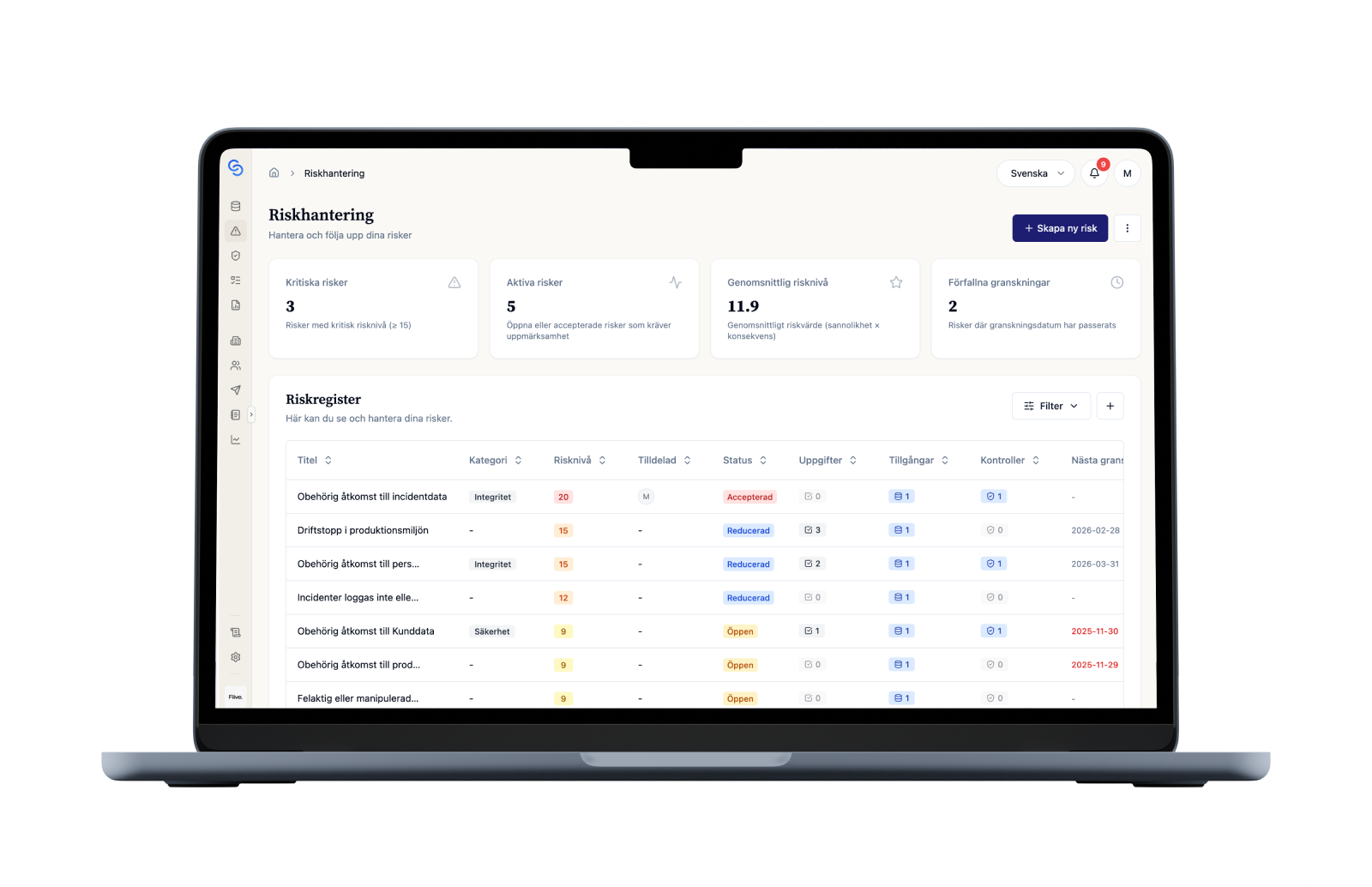

ChainSec is a GRC platform that connects your internal security work with risks in the supply chain. By gathering everything in an Integrated Risk Management (IRM) system, you get a total overview – optimal for those who want to avoid managing multiple different tools.
Your security is only as strong as your weakest link. Get an automatic overview of risks at your suppliers and act on deviations before they become incidents.
Stop with disconnected Excel lists. Build a logical chain from your critical assets, via the risks that threaten them, to the controls that protect them.

When you know which assets are most critical and which risks threaten them, you can allocate budget and resources where they do the most good.
ISO 27001 and NIS2 require a risk-based approach. With ChainSec, you get the documentation included and can easily show the auditor your reasoning.
Instead of static documents, you get a dynamic view of the security situation. When a new asset is added or a control fails, you see immediately how it affects the risk picture.
By connecting risks to assets, it becomes clear who is responsible for what. No more risks falling between the cracks.
Book a demo and we'll show you how you can handle gap analyses and supplier reviews in one system – instead of Excel. After the demo, you can test the platform for free.