Relevant risks
Link risks to the assets they could affect.
Asset register · For IT and data protection managers
Keep your systems and information assets in one shared register. Document owners, classify information by confidentiality, integrity and availability and link assets to the risks you need to address.
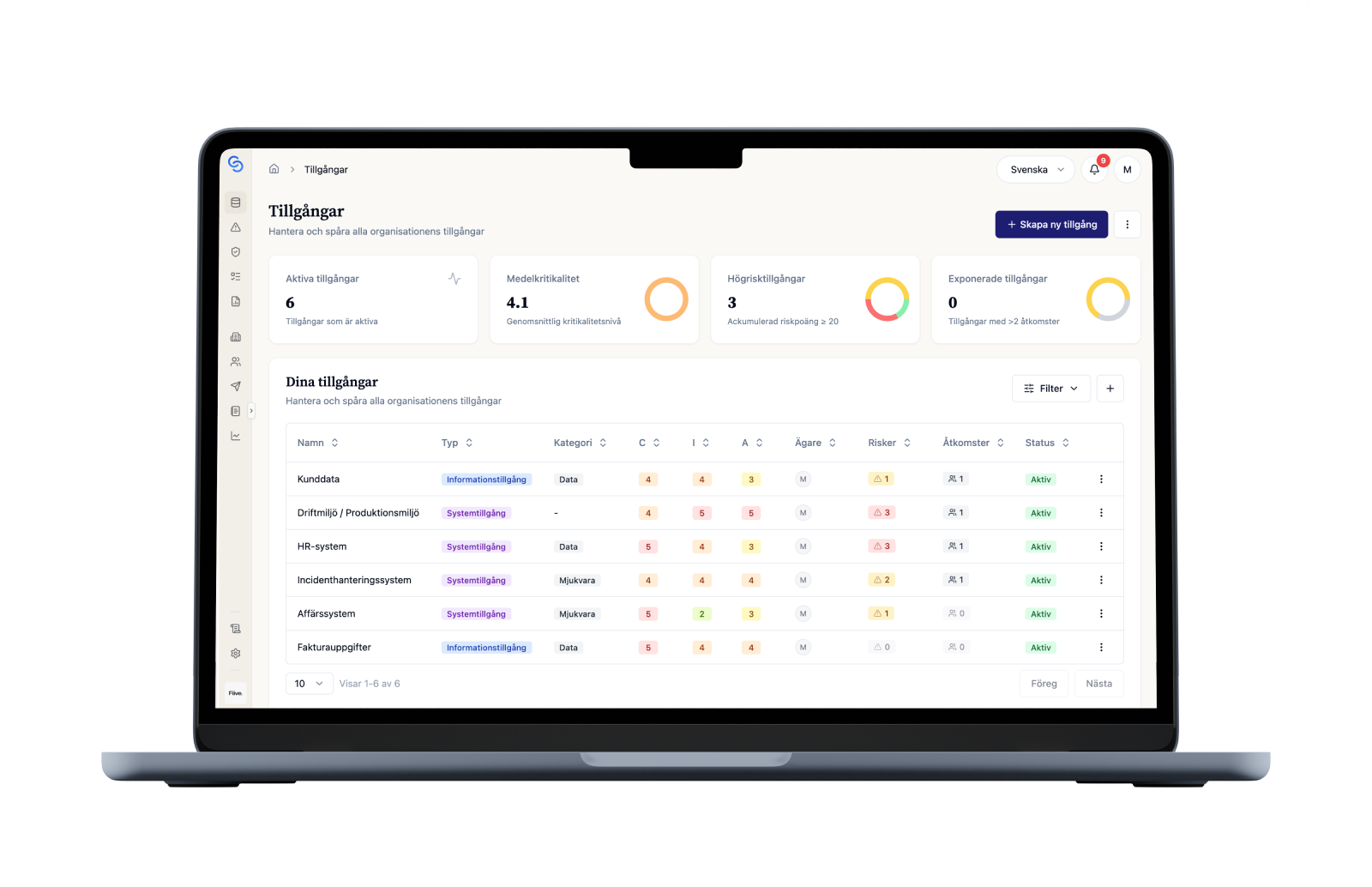
Keep systems and information assets together so you know what needs protection.
Document who is responsible for each asset and its follow-up.
Use confidentiality, integrity and availability classification and derived protection levels to guide the work.
01 · Assets
Start with the systems and information your business depends on. One shared register helps keep structure and responsibility together.
02 · Classification
Different assets need different protection. Assess information in terms of confidentiality, integrity and availability, known as KRT in Swedish.
Assess the need to limit who can access the information.
Assess how important it is that information is correct and is not changed improperly.
Assess the need for information to be available when required. Classification supports the derivation of protection levels.
03 · Connections
Documented assets give risk work a clearer foundation. Show what could be affected and which controls you are working with.
Link risks to the assets they could affect.
Keep documentation about the asset and relevant controls together.
Use asset classification and the risk assessment to guide your next step.
04 · Data protection
Data protection in ChainSec includes the asset register, information sets and an Article 30 register. This gives documentation structure when personal data needs follow-up.
Document the information handled in your business.
Keep documentation of personal data processing activities in a register.
Data protection is added on top of Risk and requirements within the GRC offering.
You can register systems, applications and information assets important to the business and connect them to ownership and risks.
You assess protection needs in terms of confidentiality, integrity and availability. ChainSec supports this classification, known as KRT in Swedish, and the derivation of protection levels.
Yes. You can document an owner for each asset to make responsibility and follow-up clearer.
Risks can be linked to assets. You can then see which information or systems are affected and use classification to help set priorities.
Data protection includes an Article 30 register and information sets alongside the asset register. It is sold as an add-on to Risk and requirements. The records help structure your work; you remain responsible for assessing your personal data processing.
We show the asset register, information classification and data protection features based on your business needs.